Six modules. One connected system.
TourNex isn't six separate tools bolted together. Each module is built on the same data model, so an advance in one place updates the rundown in another, and the rider feeds the venue brief.
The spreadsheets stop here.
A single record of every show.
Advance sheets, day sheets, rundowns, riders, venue specs, and settlements live in one place — versioned, shareable, and always current. No more emailing v17 of a spreadsheet at 2 AM.
Designed by people who've run shows.
Every workflow in TourNex was modeled on the way real tours actually run — the language, the steps, the handoffs. You won't have to translate your job into someone else's idea of it.
When one thing changes, everything updates.
The rider drives the venue brief. The advance drives the day sheet. The settlement reconciles against the original deal. Change one input and the whole production stays consistent.
The parts that took a road career to figure out.
Every tour platform can hold a schedule. These are the things that only get built by someone who has had the problem at two in the morning.
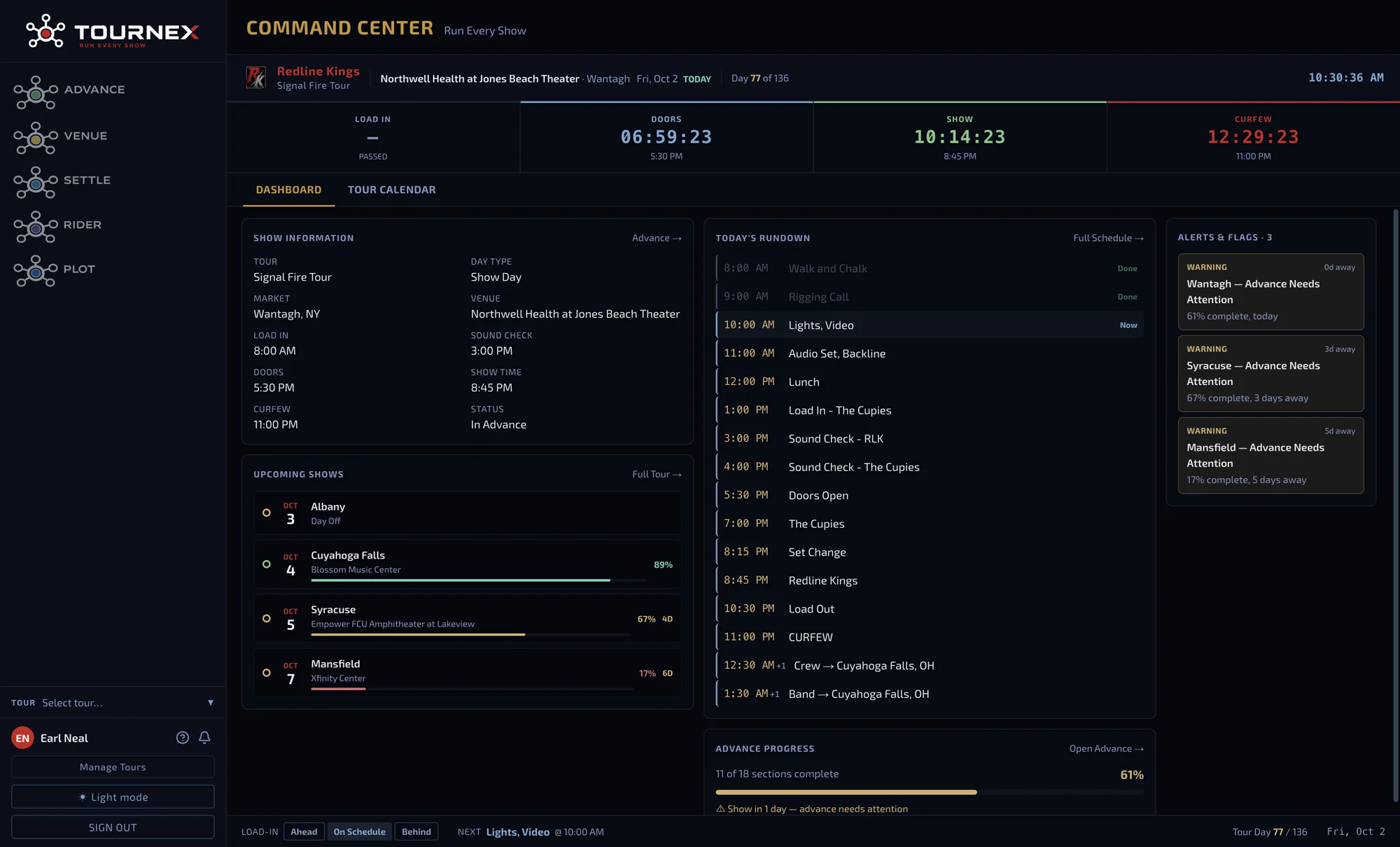
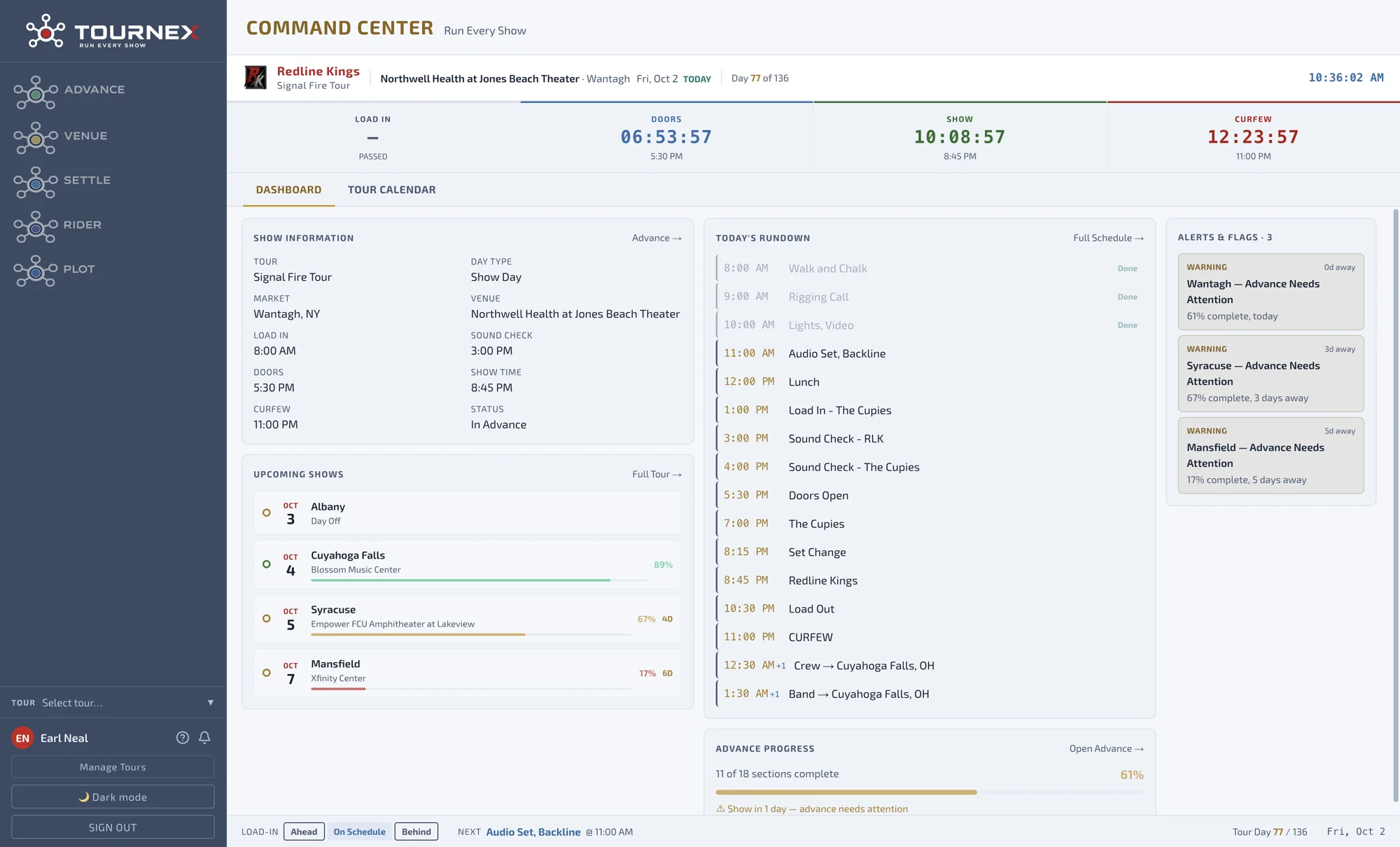
Live countdowns to every key time, department notes, and the status of the day — the screen the crew keeps open from load-in to curfew.
Pulls plot data, layers in logistics, schedules, and contacts. Builds the advance sheet for every date.
A live library of room dimensions, dock access, power, capacities — and the local crew who know them.
Hospitality, technical, and production riders generated from artist preferences and venue capabilities.
Settles every show against the deal — reconciling expenses, splits, and net against the original contract.
The first true-to-scale, drag-and-drop stage plot tool. Inputs, backline, set pieces — drawn at real dimensions.
Most "tour platforms" are five tools in a trench coat.
You buy them separately, log into them separately, and reconcile their answers by hand. The rider lives in one place, the advance in another, the day sheet in a third, and the settlement in a spreadsheet someone built in 2014.
TourNex was designed as one platform from day one — so when the load-in time moves, the rundown, the venue brief, the crew calls, and the settlement template all move with it.
See it in the context of your tour.
Request Access →
The technical layer the rest of your show is built on.
A 60×40 stage — actually 60×40.
Every icon is a PNG drawn to its real-world footprint — so a bass rig occupies the floor space a real bass rig occupies, and a riser sits where the riser will actually sit. The plot you draw is the plot the local crew actually loads in.
Channels, mics, stands — all linked.
Input lists update with the plot. When a channel moves, every doc that references it updates too. No more reconciling FOH against monitor world by hand.
Every amp, riser, and DI in its place.
Backline, monitors, risers, and stage furniture mapped to the plot. Local crew knows exactly what goes where before the truck arrives.
Clean PDFs. No formatting tax.
Export plots, input lists, and backline sheets to clean, production-ready PDFs the moment you need them — formatted for both crew binders and the bus.
Build the day in the language tour managers already speak.
Day type, venue link, show type, billing, support acts, catering count, ages, notes — the same fields you'd advance over the phone, structured and reusable from one show to the next.
The advance sheet, replaced by a working document.
One page. Every show. Every day.
Day sheets generate from the underlying advance — load-in, sound check, doors, set times, contacts, weather, parking. Print, share, or pin to the bus wall.
Built in the language you already use.
Sections, fields, and prompts that match how tour managers and production managers actually work — not a generic CRM dressed up for the road.
A live schedule, not a frozen PDF.
Move sound check, and everything downstream updates. The rundown, the crew calls, and the day sheets all reflect the change — instantly.
Every promoter, every venue contact, in one rolodex.
Contacts are first-class objects, attached to venues and shows. Last time you played the Greek? The promoter's number is right there.
A working knowledge of every room you'll ever play.
Dimensions, dock access, power, capacities.
The structural information your production needs to plan against — kept current, owned by the venue, accessible to the touring side.
The people who actually know the room.
Stage managers, audio leads, riggers, and stagehands tied to each venue. Who worked your last show. Who's available for the next one.
Every show you've ever played here.
Past advances, settlements, notes, and lessons learned. The institutional memory of a room, always within reach.
What happened last time you were here.
Attach photos, parking maps, and dock notes to each visit — so next year's advance starts with what you learned this year.
Venue is the source of truth for the room.
Every preference, structured as a field — not buried in a PDF.
Contacts, allergens, dietary restrictions, all-day items, meal periods — fields the venue can read at a glance. Versioned with revision numbers, ready to preview, print, and ship.
A rider that reflects what the show actually needs.
Dressing rooms, catering, transport.
Every preference, every requirement, structured as fields you can update once and apply everywhere — not buried in a 22-page PDF.
Structured, not a 22-page PDF.
Technical requirements captured as fields the venue can read at a glance, versioned with revision numbers and ready to print.
Crew calls, security, transport.
The production rider — what you need from the venue's side to make the day run — built and shared in the same place as everything else.
Every rider carries its revision.
Riders are versioned with major and minor revision numbers and an optional version name, so the venue can confirm it is working from the current one.
Rider sets the standard. The platform delivers it.
Settlements traceable back to the contract.
The contract follows the show.
Guarantees, splits, caps, and bonuses are recorded at deal time and surfaced at settlement — no more digging through email for what was actually agreed.
Categorized as they're entered.
Expenses are categorized as they're entered — local crew, hospitality, ground transport, production — so reconciliation isn't a translation job at the end of the night. Deal terms are captured up front, including from an uploaded deal memo.
Where did the show beat — or miss — the deal?
Every settled line is checked against the deal. Variances flag automatically. Tour-wide views roll show-by-show performance into one read.
Clean settlement reports. On the bus.
Final settlement statements print as production-ready PDFs, filed against the tour.
The screen that stays open from load-in to curfew.
Every key time, counting down.
Load-in, sound check, doors, set times, curfew — each counting down in the same color it carries on the schedule. Inside fifteen minutes it pulses. Times that have passed mute themselves.
What your department needs today.
The notes that matter to your department, on the same screen as the clock — so nobody is hunting through a group text for the one line that changed.
One-handed, in a loading dock.
Command Center holds the screen width on a phone instead of drifting sideways. It installs to the home screen and opens like an app.
One schedule, not a second copy.
Move sound check in the advance and the countdown moves with it. There is no second schedule to keep in step.
Command Center is the day-of view.
Tour Managers
Logistics, communication, accountability, scheduling. The role with thirty browser tabs and one bus to keep on time.
Production Managers
Technical information, execution, coordination. The role that has to know — before load-in — whether it'll fit, whether it'll hang, whether it'll power.
Venues
Accurate advance information, riders, stage layouts, settlement information, operational consistency. Showing up prepared, every load-in.